iCliniq Tes
Designed the conversational AI experience for Tes, iCliniq's AI-assisted health companion - crafting a trusted, accessible interface for weight-loss drug guidance, built on expert physician knowledge.
View live project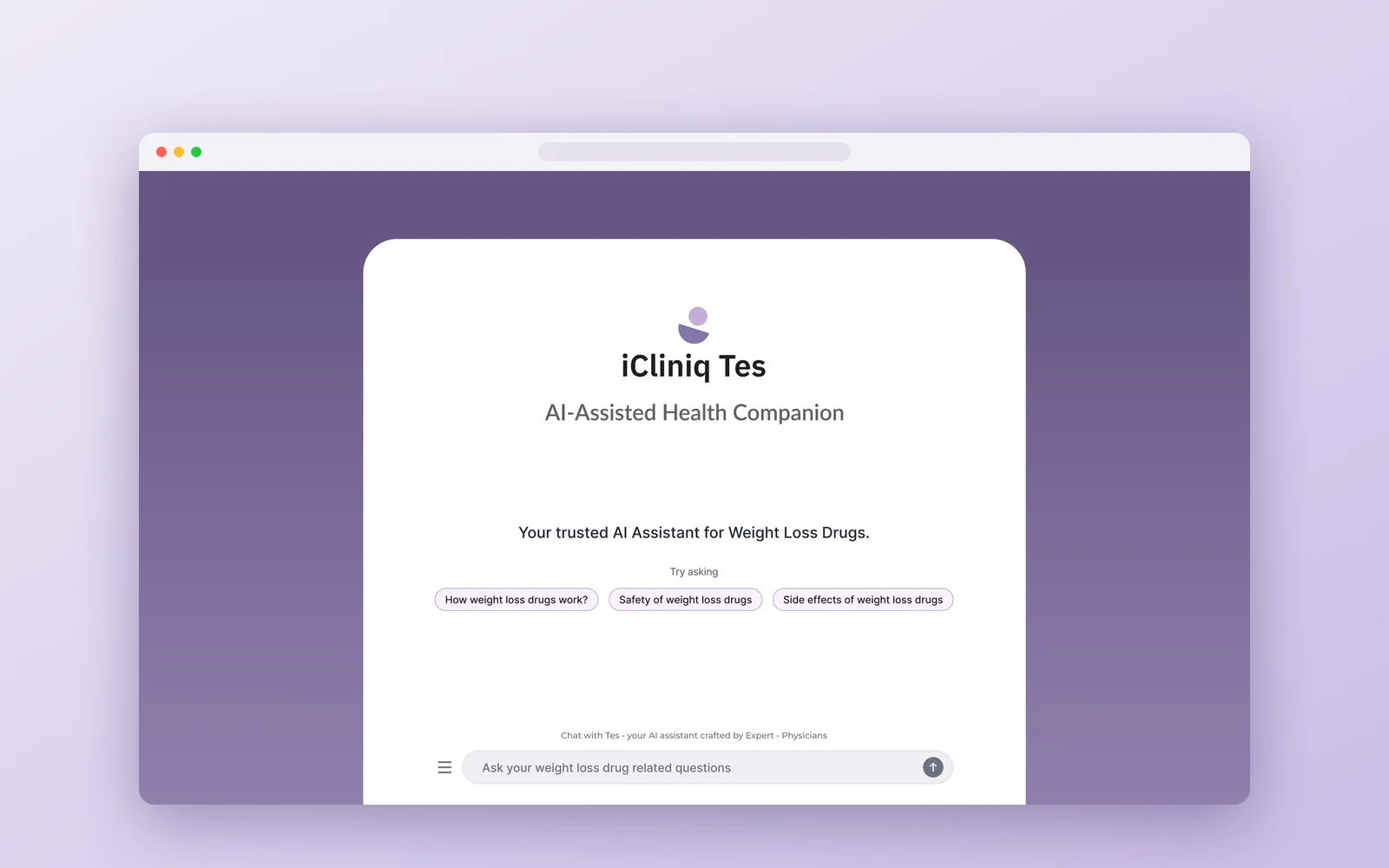
- Problem
- Patients drown in health advice that all sounds equally confident - and distrust AI in medicine by default.
- My role
- End-to-end experience design: conversation architecture, interaction patterns and high-fidelity UI.
- Outcome
- A companion that shows how it reached each answer and hands off to a real physician when it should. Live across 25 conditions.
- 25Condition modules live
- 3-stepVisible reasoning per answer
Overview
iCliniq Tes is an AI-powered health companion built to give patients instant, trustworthy answers to their medical questions. It runs on iCliniq's Golden Data - a proprietary, medically-validated database built from millions of real physician-patient interactions - and uses RAG (Retrieval-Augmented Generation) to ground every response in verified clinical evidence.
I was responsible for the end-to-end experience design: conversation architecture, interaction patterns, and high-fidelity UI across condition-specific modules, starting with the Weight Loss Drugs specialization.
Problem
The challenge in digital health isn't a shortage of information - patients are overwhelmed by it. What they lack is a reliable source. Search results, AI tools, and health forums all speak with the same confidence regardless of accuracy, leaving users unable to tell credible guidance from noise.
iCliniq had the clinical depth to solve this. The design problem was making that depth visible - building an AI experience that actually felt as trustworthy as it was.
Research & Users
Tes serves two primary users: patients managing a diagnosed condition, and individuals researching symptoms or medications before speaking to a doctor. Both groups want answers quickly - but they're skeptical by default, especially in a medical context.
A few patterns shaped the design:
- Users distrust AI in medical contexts - they need to see how an answer was derived, not just the answer itself
- Vague or over-hedged responses frustrate users more than they reassure them
- Without a clear next step when things escalate, users disengage entirely
Solution
The entire experience is built around making the AI's confidence earned. The core design decisions:
- Transparency Engine - every response shows a 3-step breakdown of how Tes reached its answer: intent mapping, evidence retrieval from Golden Data, then medical verification. Users see the process, not just the output
- Guided entry - three pre-seeded prompt chips lower the barrier for users who don't know where to start, surfacing the most common questions upfront
- Clinically calibrated tone - the language is modelled on a US-certified physician: direct, warm, and never evasive
- Content reinforcement - each response links to verified articles, so trust extends beyond the conversation itself
- Physician escalation bridge - a persistent, clearly labelled path to consult a real iCliniq doctor when the query needs professional judgment
Challenge
The hardest constraint was also the most important: Tes cannot diagnose or prescribe, ever. That's a hard product rule, but enforcing it poorly destroys the experience. An AI that just deflects every sensitive question with a disclaimer feels useless.
The solution was making the escalation feel like a feature, not a wall. When a conversation reaches a point of clinical concern, Tes responds honestly - acknowledging what it can't do - then immediately offers a direct path to an iCliniq physician. The handoff is smooth enough that users don't feel abandoned, they feel guided.
Scaling this across 25 condition-specific modules added another layer of complexity. Each module shares the same experience framework but is trained on a distinct dataset, which meant designing a component system in Figma flexible enough to accommodate different conditions, tones, and user contexts without rebuilding from scratch each time.
Summary
This project pushed me to think carefully about what trust actually looks like in an interface. In healthcare especially, trust isn't aesthetic - it's structural. It comes from showing your reasoning, setting honest expectations, and never leaving users without a path forward.
Tes is currently deployed across 25 medical conditions and continues to evolve. Upcoming features I contributed to the roadmap - including conversational memory, dynamic prompts, and a multi-condition reasoning layer - are aimed at making the experience feel less like a tool and more like a companion.
I design for clarity, not decoration. Let's build something people can trust.
Open to product design roles and collaborations - in Bangalore, Chennai or fully remote.
Let's talk